Front ends: springer, glide, or the one you already have
The front end decides how the bike steers, how long it looks and what your frame has to be cut to. Pick it first. Here is what each type actually does, and the mistake that costs people a second set of forks.
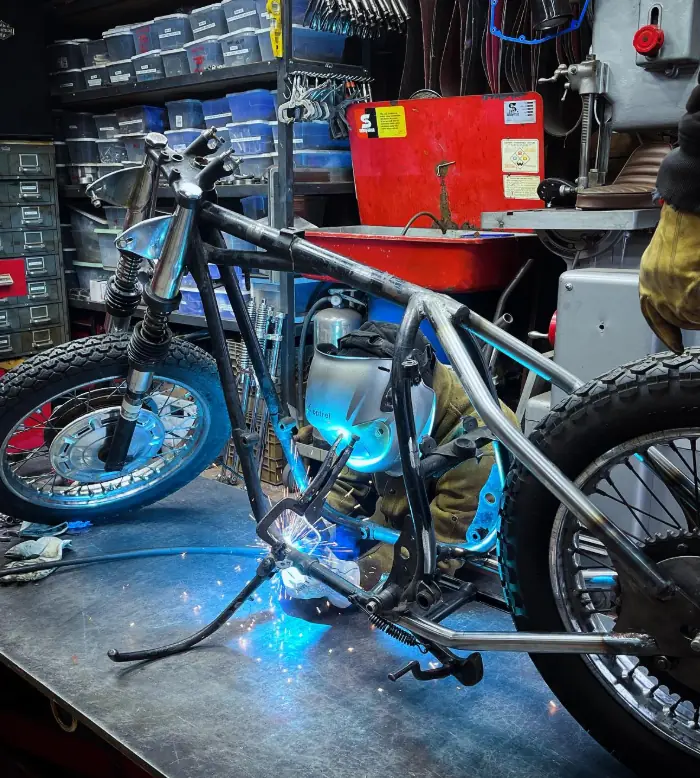
People decide the front end last, after the frame is cut and the stance is set. It is the wrong way round, and it is the single most expensive order of operations in building a chopper. The front end decides the rake. The rake does not decide the front end.
Here is what each type does, what it costs you, and the mistake we see most.
Springer
Two sets of legs — one rigid, one sprung — with the spring pack and rockers out front. No hydraulic damping, or very little.
What it gives you: the look, and the reason most people are reading this. A springer puts the wheel further out for the same rake angle, so it reads longer without cutting more frame. They are also rebuildable forever, which matters on a bike you intend to keep.
What it costs you: damping. A springer stores energy and gives it back, so it moves more than a glide over the same road, and it wants a smooth surface and a hand that expects it. Springers are also sold by length above stock — “plus 4”, “plus 8” — and that length is measured from a stock item you may not own.
Narrow glide
Conventional hydraulic telescopic forks in narrow trees.
What it gives you: damping, predictability, and parts on a shelf anywhere in the world. It is the front end for a bike that gets ridden rather than parked, and for anybody who wants the bike to behave the same on the third hour as it did on the first.
What it costs you: a little of the look, and the fact that extending a glide badly is genuinely dangerous — tubes have a working length for a reason.
The one already on the bike
Worth saying out loud, because nobody sells it: leaving the stock front end on a stock frame and spending the money on the back half is a legitimate build. Stretch and drop change the stance more than most people expect, and a stock front end with a hardtail already looks nothing like the bike you started with.
The mistake, and it is always the same one
Raking the frame and leaving a stock-length front end on it.
Opening the steering head angle pushes the wheel forward, and unless the front end gets longer at the same time, the whole nose of the bike drops. The result sits wrong, steers worse than it did before, and hits everything on the road. The two numbers have to be worked out together, every time.
If somebody quotes you a rake without asking what front end you are running and how long it is, they have not done the sum. Walk.
What to measure before you order anything
- Your current fork length, centre of the axle to the top of the top tree. Not “stock” — the actual number, because the bike may already have been modified by somebody who never mentioned it.
- Front tyre size, as written on the sidewall.
- Steering head angle if you know it. If not, say so — it can be worked out from photographs.
- What the bike is for. A bike that is ridden every weekend and a bike that rolls out twice a summer are not the same brief, and they do not get the same answer.
The short version
Choose the front end. Then the rake follows. Then stretch and drop set the stance. Then everything that has to fit around all of it — tyre, fender, exhaust, chain, brake rod — gets checked before anything is welded.
Do it in that order and the bike is right the first time. Do it backwards and you buy the front end twice.